Corroboration Over Conviction: Building an NCLEX Question Engine That Doesn't Trust Itself
How I built an NCLEX question engine that doesn't trust itself — corroboration over conviction, and why a model's confidence is not its accuracy.
A single model will answer a nursing-exam question with exactly the same confidence whether it is right or whether it is confidently, dangerously wrong. It has no idea what it does not know. That is not a cheap shot at any one model — it is a well-documented property of the current generation: left uncalibrated, a model's stated confidence and its actual accuracy are only loosely related, and the alignment training that makes these systems pleasant to talk to tends to make them more overconfident, not less. That one problem is the entire design brief for the last stretch of my work — an AI study tool for the NCLEX, the licensing exam every nurse in the United States has to pass — so rather than assert that the thing is trustworthy, I would rather show you what "trustworthy" actually costs to build.
Start with the corpus, not the model
Everything begins with the reference corpus — the ground truth against which the system reasons. Ours is nursing-specific and built from primary sources: FDA drug labels, DailyMed, and current clinical guidelines, chunked and embedded with bge-m3 into an isolated vector store that touches nothing else we run. The isolation is deliberate. Clinical language that is correct and required here would be a compliance problem in a marketing corpus, so the two never share a store, an index, or a verifier.
Then distrust the corpus
A corpus is not true simply because you assembled it carefully. So we re-verified it — 946 chunks, each one grounded fresh against primary sources and judged by a model. That first pass flagged 95 chunks as contradicted or outdated. Here is the part worth the price of admission: when I ran those 95 flags past a second, independent model — a different lab entirely — 83 of them cleared as false positives. Roughly seven of every eight of the first model's confident "this is wrong" verdicts were themselves wrong, usually because it had pulled the wrong label variant or summarized a source incompletely. The lesson is not subtle: never quarantine on one model. Confidence is not accuracy, and a lone judge is just a second author.
Generate on demand — but let nothing through unchecked
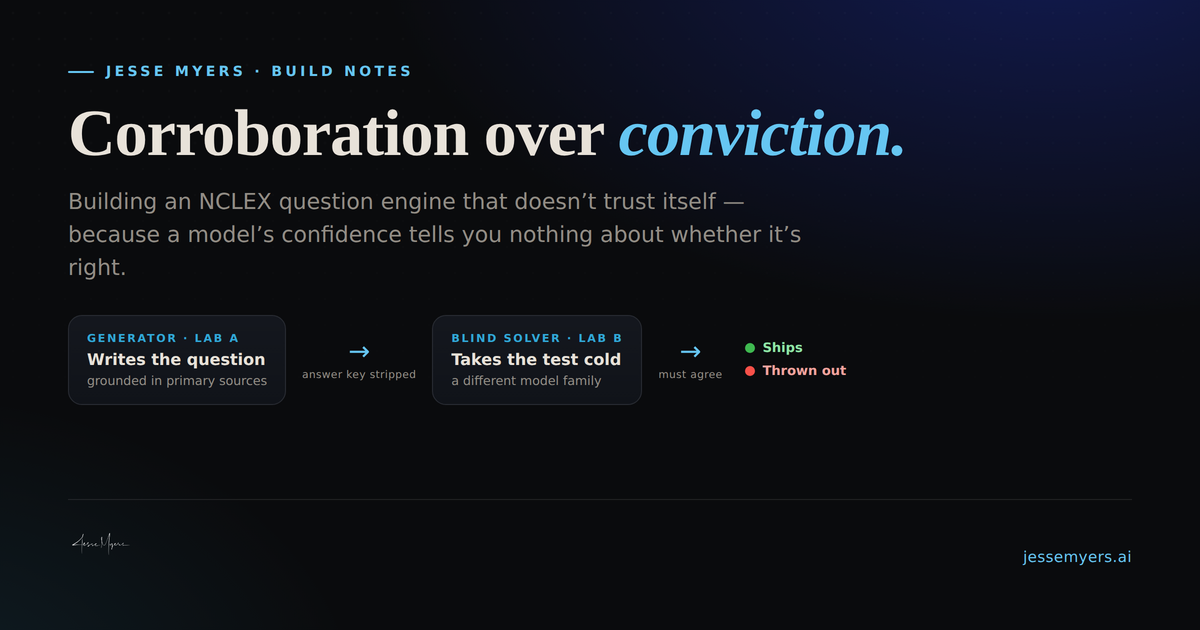
Students do not want a static bank; they want fresh questions tuned to where they are weakest. So questions are generated on demand, and every one of them runs a gauntlet before a student ever sees it. The pipeline grounds forward first — a live retrieval of current, exam-accurate facts — pulls the matching chunks from the corpus, and only then asks the generator, GLM-5.2 running at the edge, to write the item. Then come the checks: deterministic rules first (exactly four options, one defensible answer, dosages recomputed, retired guidance denied), and then the one I like most — a blind solve. A different model, from a different lab (gpt-oss-120b), is handed the stem and the options with the answer key stripped out and told to take the test. If it does not independently land on the keyed answer at high confidence, the item does not ship. The author never grades its own exam. That check earns its keep — it is a known validity technique, "roundtrip consistency" — but it is a floor, not a ceiling: it proves the item is answerable and internally consistent, not that the keyed answer is beyond dispute. That last part is a harder question, and it is where the humans come back in.
Why two labs, and not two runs of one
Because a model agreeing with itself proves nothing. The generator and the verifier come from different model families on purpose, so that a passing verdict has to survive a genuinely independent opinion. When the two disagree, a third cross-lab adjudication breaks the tie. It is corroboration, engineered — the same instinct a good clinician has, pointed back at the machine that is trying to teach one.
The example that ended the argument
One item keyed "administer potassium" for a patient in diabetic ketoacidosis with a potassium of 3.2. The cross-lab judge flagged it: at that level, current practice is to hold the insulin first, because insulin drives potassium into the cells and can drop an already-low value into fatal territory. That is not a typo a keyword filter catches — it is precisely the sort of confident, plausible, wrong answer that must never reach a student the night before an exam. It is also why the model judge is a floor and not a ceiling: it is a proxy for ground truth, so a registered nurse still rules on the genuinely debatable items. The machine narrows the human's workload to the hard cases; it does not replace the human.
Map it to the reasoning the exam actually tests
Recall is the easy part. The Next Generation NCLEX tests clinical judgment through a six-step model — recognize cues, analyze cues, prioritize hypotheses, generate solutions, take actions, and evaluate outcomes — so every question is tagged to one of those six skills, and the unfolding case scenarios walk a student through all of them the way the real exam does. The Socratic tutor answers in the exam's own terms and stays inside the grounded corpus; it will tell you what it does not know rather than invent a lab value, which, for a nursing student, is the only acceptable failure mode.
One honest caveat, because the whole point is honesty
The pilots here are pilots — directional signal, not a verdict — and the model judge is a proxy, not the truth. That is not a hedge; it is the design. The system is built to earn a narrow, checkable, revocable kind of trust, one question at a time, which is the only kind of trust worth giving a machine that is helping someone become a nurse.