Help the Student, Don't Do the Work: Building AI for School That Refuses to Cheat
The easiest money in ed-tech is a machine that writes the paper for you. I refused to build it. Here is what I built instead — a Socratic tutor, a grader that critiques but never composes, professor intelligence that never fabricates, all bounded by each school’s own academic-integrity policy.
The easiest money in education technology right now is a machine that writes the paper for you. Point a language model at a prompt, wrap it in a friendly interface, and charge a monthly fee. Students will pay. I refused to build that, and I want to explain why, and what I built instead — because the refusal is the whole product.
An AI that does the assignment for you is not a tutor. It is a way to not learn, sold back to you as help. The entire value of school is the struggle that changes how you think; a tool that removes the struggle removes the point and leaves you with a transcript that lies about what you can do. So the line I drew on the study tool I built is simple to say and hard to engineer: help the student learn, and never do the learning for them — inside each school's own rules, not my opinion of them.
Built for the actual course, not a generic subject
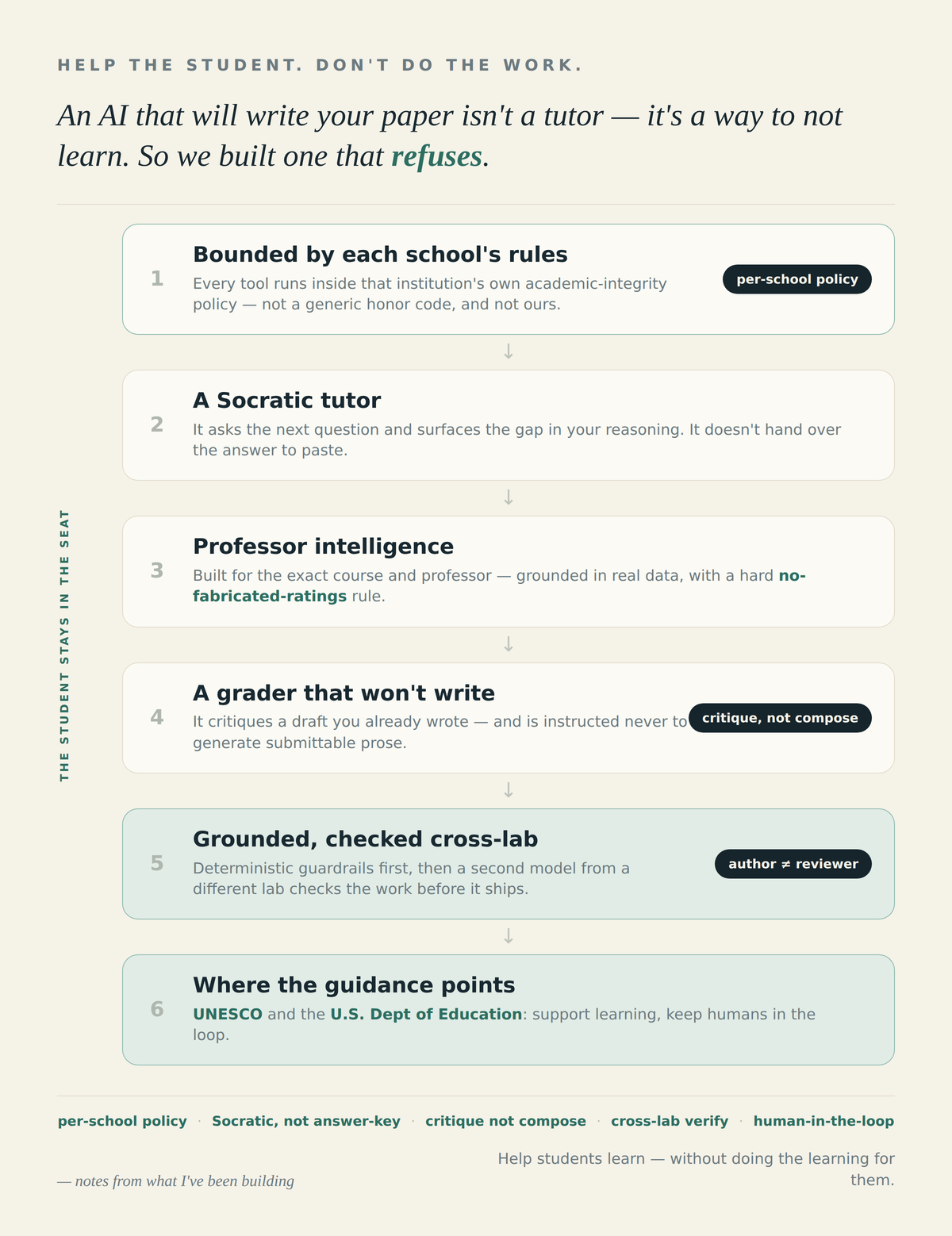
The tools are built for a student's exact course and professor — what we call professor intelligence. That specificity is what makes it useful, and it is also where the first ethical trap sits: it would be easy to invent a professor's reputation to make the pitch land. So there is a hard rule in the system that it may not fabricate a professor's ratings or record. If we do not have real data, it does not get made up. A study tool that lies about your professor is just a different kind of cheating — on the student, this time.
A tutor that asks the next question
The tutor is Socratic on purpose. It is built to ask the next question, surface the gap in your reasoning, and make you take the step — not to hand you the answer so you can paste it and move on. The pedagogy is the guardrail. A tutor that just answers is a search engine with a nicer voice; a tutor that makes you produce the reasoning is the thing that actually moves a grade, because it moves the student.
A grader that will not write
This is the one I am most careful about. The essay tool assesses only writing the student has already produced. It is built to critique a draft — structure, argument, evidence, clarity — and it is instructed never to generate submittable prose. It will tell you your thesis is weak and why. It will not write you a stronger one to turn in. It grades; it does not ghostwrite. The distinction is the entire ethic, and it is enforced in the tool's instructions, not left to a student's good intentions at 2 a.m.
Inside each school's rules, not mine
Every one of these tools runs bounded by the academic-integrity policy of the specific institution it serves — not a generic honor code I wrote, and not my personal read of what is fair. The rules about what help is permitted are the school's to set. The tool's job is to honor them. That is a deliberate transfer of authority: I do not get to decide what counts as cheating at your university; your university does, and the tool is built to stay inside that line.
Grounded, and checked by a second model
None of this matters if the tool is confidently wrong, so the content is grounded in a real corpus for each subject and checked before it ships: deterministic guardrails first — the answer key, the required format, a denylist of retired guidance — and then an independent model, from a different lab than the one that produced the content, judging whether it holds up. A study tool that hallucinates is worse than no tool, because a student cannot tell the difference. The author never grades its own work; that rule applies to the machine before it applies to the student.
This is where the guidance already points
I did not invent this posture. UNESCO's guidance for generative AI in education is explicitly human-centered: protect human agency, use these tools to support learning rather than replace it, and validate the tools before turning them loose on students. The US Department of Education's Office of Educational Technology report on AI in teaching and learning lands on the same phrase everyone who takes this seriously lands on: keep humans in the loop. Building the tool to help rather than to do the work, bounded by the institution's own policy, with a human student kept firmly in the seat where the thinking happens — that is not me being ahead of the standard. It is me building to it.
Why I bother
I could have shipped the paper-writer. It would have made money, and it would have quietly made its customers worse at the one thing they were paying a university to teach them. I would rather build the tool that makes the struggle productive than the one that sells the illusion of skipping it. Learning is supposed to cost something. The most useful thing an education tool can do is make sure the student is the one who pays it.