Most Certifications Prove You're a Good Partner. This One Wants Receipts.
I don't put much stock in most vendor certifications anymore. I've held plenty of them, across plenty of years, and somewhere along the line I made my peace with what the median one actually measures: that you showed up, paid the fee, and stayed a cooperative partner to the vendor whose logo sits at the top of the certificate. They prove loyalty more reliably than they prove depth. You can memorize your way through most of them over a weekend, and everyone in the room knows it.
That is not a blanket indictment. Not all certifications are the same, and mileage varies by vendor and by program — a handful are genuinely difficult and genuinely mean something. But the average one tests your willingness to sit an exam, not your ability to build the thing the exam describes.
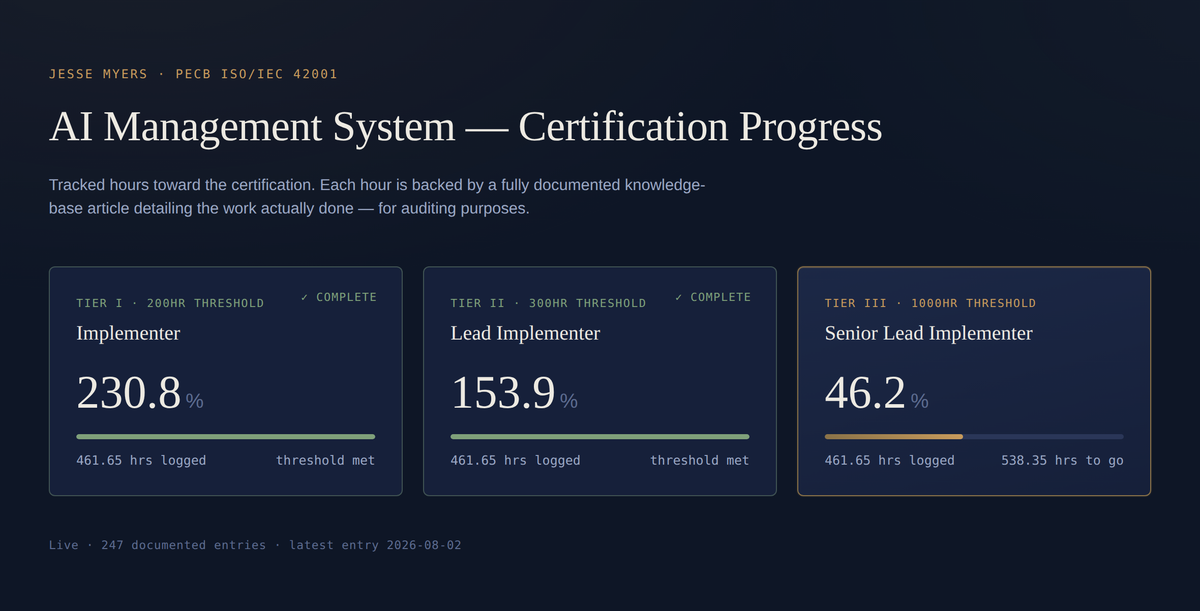
So I decided to go a different way, with a certification I thought had some real weight behind it — one that asks for more than a passing score. It asks for the work. To earn the credential, you pass the exam and you document real implementation hours logged against specific topics — hours of actual project activity, not seat time. The program tiers those hours: 200, then 300, then 1,000. I am chasing the top of that ladder, and I am just past 460 — so call it halfway, each hour recorded against the specific thing toward which it went.
The standard is ISO/IEC 42001. Published at the end of 2023, it is the first international standard for managing artificial intelligence — an AI Management System, in the same family as ISO 27001 for information security and ISO 9001 for quality. It gives an organization a real, auditable framework for governing AI responsibly: assessing risk across the AI lifecycle, keeping humans in the loop, documenting decisions, and watching for bias and drift. It is the difference between saying "we use AI responsibly" and being able to show your work when someone makes you.
One distinction worth drawing, since the two get conflated constantly: ISO/IEC 42001 certification exists at two levels. An organization can be certified — audited to prove that its AI management system conforms to the standard. A person can be certified — credentialed as competent to implement one. What I hold is the individual credential, earned personally; it certifies the practitioner, not the payroll. The 1,000 hours are how a person proves that competence rather than merely asserting it.
That is why it appealed to me. I have spent the better part of two years building AI systems whose entire premise is that confidence is not accuracy — that a system should substantiate what it claims rather than merely assert it. A certification built on the same idea — show the work, log the hours, prove it — is one I do not mind earning the slow way.
Ask me again in another 540 hours.