I Didn't Pick a Model. I Drafted a Team.
Three AI jobs, two cheap open models, one independent judge — and three different winners. Right model, right price, per job.
I have one operating rule I have bored everyone who knows me with: don't assume — verify every answer. Lately it has a companion that is almost as unglamorous — don't pick a model, pick a model per job. This week I stopped theorizing about that and ran the bake-offs.
The setup: an exam-prep platform I build, three different AI jobs — a Socratic chat tutor, an on-demand question generator, and multi-step unfolding case scenarios — and two cheap, open models running on Cloudflare's edge as the contenders. Llama 3.3 70B (Meta, fast, no visible reasoning) against GLM-5.2 (Zhipu, a reasoning model that thinks in paragraphs). An independent model, gpt-oss-120b, sat as the judge, and I kept the whole thing on exams with clean public ground truth — commercial-driver's-license rules and real-estate licensing — so scoring was not a matter of taste.
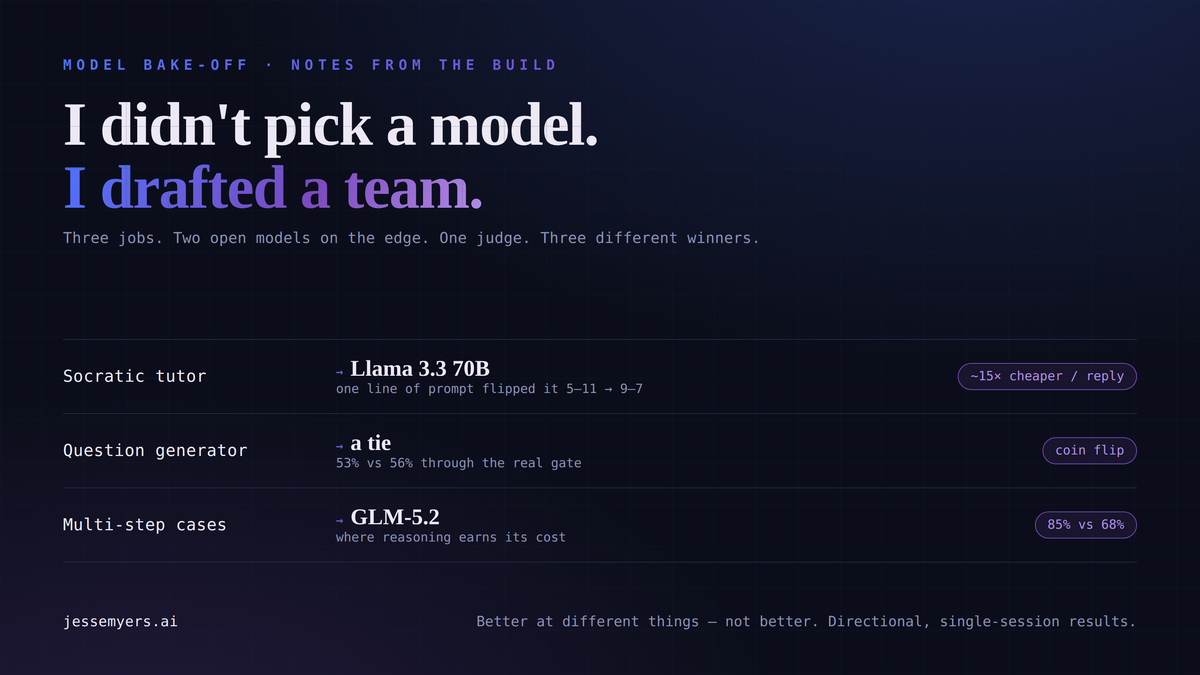
Three jobs, three different answers.
The tutor went to Llama, but not at first. On the stock prompt, GLM was the better teacher — it stated the fact, then asked a guiding question, while Llama stayed purely Socratic and withheld the rule. Then I changed one line of the prompt — "state the fact, then ask" — and the blind head-to-head flipped from 5–11 against to 9–7 in favor, at roughly two-and-a-half to three times the speed and about fifteen times lower cost per reply, with zero factual errors in a grounded audit. One sentence of instruction, and the cheap fast model became the better tutor. I switched the live tutor to it.
The question generator was a tie. Through the actual production quality gate — not a lenient stand-in, the real one that checks against live sources — Llama passed 53% and GLM 56%. That is a coin flip. I kept GLM for slightly more reliable formatting, but I would have lost nothing swapping in the cheaper model. Worth knowing, not worth agonizing over.
The scenarios went to GLM, and it was not close — 85% versus 68% per-step accuracy on five-step cases. This is the job where reasoning actually earns its higher token cost, so it gets the reasoning model. Right tool, right price.
The through-line under all three: grounding is the great equalizer, but only for the model that needs it. Handing Llama the right reference to check against lifted it from a coin flip to a perfect score on catching wrong facts — 0 for 3 to 3 for 3 — and did nothing measurable for GLM, which was already accurate. And a tight, on-point rule beat three loosely retrieved passages, three for three against one for three. More context is not better context.
My favorite result is the one that made me feel dumb, which is usually the useful kind. The multi-step cases had a low whole-case pass rate, and I went looking for the model to blame. It was not the model. The gate required all five steps to pass, and 0.85 to the fifth power is 44%. The ceiling was arithmetic. The fix was the gate, not the AI. I had been about to optimize the wrong thing — which, if I am honest, is most of the job.
A caveat I want to state plainly, because it is the whole spirit of doing this at all: these are directional, single-session results, not a peer-reviewed benchmark. One line of prompt already flipped an entire matchup once — another tweak, better grounding, or a larger sample could move any of these the other way, and I would rather update than defend. That is the point. You measure, you route each job to whatever wins it today, and you stay willing to be wrong tomorrow. Confidence is not accuracy — for the models, and for the guy running the bake-off.
None of this makes one model better than the other — it makes them better at different things, which is a more useful fact and a more honest one. Each of these earned the best score on performance, accuracy, stability, and price for the specific job it was tested on, on this specific day. I did not pick a favorite model. I drafted a team, put each one where it earns its keep, and wrote down the score so I can check it again when something changes.