I Made the Most Advanced AI Model I Have Admit Its Mistakes
One confident, well-written answer — with two real errors buried inside. The cross-lab, cross-model verifier I built to make even the best AI defend every claim, and what it caught on a plain history question.
The fix for unreliable AI isn't a smarter model. It's making models check each other.
I just watched the most advanced AI model I have access to sit there and calmly admit it had gotten things wrong — after I essentially used four other models to poke holes in its answer. Not a crash, not a hallucination it walked into on its own. A confident, well-written, four-paragraph answer that turned out to have a couple of real errors buried inside it, surfaced only because something forced the model to defend its claims one at a time.
I spend a serious amount of my time these days on exactly this problem: how do you get output from AI that you can actually trust? Not "sounds right." Not "reads well." Trust. Because the dirty secret of even the best models is that confidence and correctness are two completely different things, and a single model has no reliable way to tell you which one you're looking at.
So, because I have a slightly warped sense of fun, I built something to prove the point.
One model is a single point of failure
Here's the core issue. When you ask one model a question, you get one model's answer — shaped by one training run, one set of blind spots, one way of being wrong. If that model is confidently mistaken about something, nothing in its own head is going to raise a hand and object. It doesn't know what it doesn't know. It just keeps talking, in the same smooth, authoritative voice it uses when it's dead right.
That's fine when the stakes are low. It is a genuine problem the moment the answer matters — a medical detail, a legal citation, a number someone is going to act on, a "fact" that's about to get repeated as gospel. A wrong answer that sounds correct is more dangerous than an obvious mistake, because nobody stops to check it.
The way out isn't to wait for a smarter single model. It's to stop treating any one model as the final word.
What I built: a cross-lab, cross-model verifier
The system I put together runs on Cloudflare and does one thing: it takes a claim and tries to break it, using models from different labs so they don't share the same blind spots.
It pairs two kinds of models on purpose:
- Reasoning models (GLM-5.2 and GPT-OSS) — the ones that actually think through whether a claim holds up.
- Search/grounding models (Sonar and Exa) — the ones that go pull live evidence from the open web instead of leaning on what a model happens to "remember."
The "cross-lab" part is the whole point. GLM and GPT-OSS come out of different labs; Sonar and Exa are different search providers. If you check a claim with two systems that were built the same way, they tend to be wrong in the same places — you get a confident second opinion that shares the first one's blind spot. Mixing labs is how you catch the errors a single family of models would sail right past.
Then I did the part I've mostly avoided doing until now: I wrapped it in a custom connector so it can be called from one of those AI apps you install on your computer — the kind most people already have open all day. And I want to be clear about something: it doesn't matter which one. Claude, ChatGPT, Gemini, Copilot — pick your favorite. They're all genuinely good, and they all have the exact same issue: each one is a single model giving you a single, confident answer, with no built-in way to tell you when that answer is quietly wrong. The verifier plugs into whichever one you use. Once it's connected, the workflow is stupidly simple. The app surfaces a claim, and you say: "Verify that with the verifier." It goes to work.
The test: Belleau Wood
To actually try it, I asked one of those apps a plain history question: "What happened at the Battle of Belleau Wood?" It gave me a solid four-paragraph answer — the kind of response you'd read, nod at, and never think to question.
Then I said, "verify that with the verifier."
Two honest trade-offs up front: it took a while to run, and it cost about seventy-five cents for this single verification. That's the tax on rigor — you're firing up multiple models and live web searches to interrogate every claim instead of trusting one pass. For a throwaway question, not worth it. For anything you're going to stake a decision or your reputation on, seventy-five cents and a couple of minutes is nothing.
What it caught
The verifier broke the answer into 20 distinct claims and went at each one independently. The verdict:
- 18 of 20 held up against independent web evidence — 13 of them cleanly, at 75–95% confidence, and 5 that were supported but came back with caveats (disputed attributions, uncertain casualty figures, accounting nuances — real history is messier than a clean paragraph makes it sound).
- 2 were flat-out contradicted.
The two it killed are the interesting part, because they're exactly the kind of confident, plausible, widely-repeated errors a single model will hand you without blinking. Here's what came back on screen, verbatim:
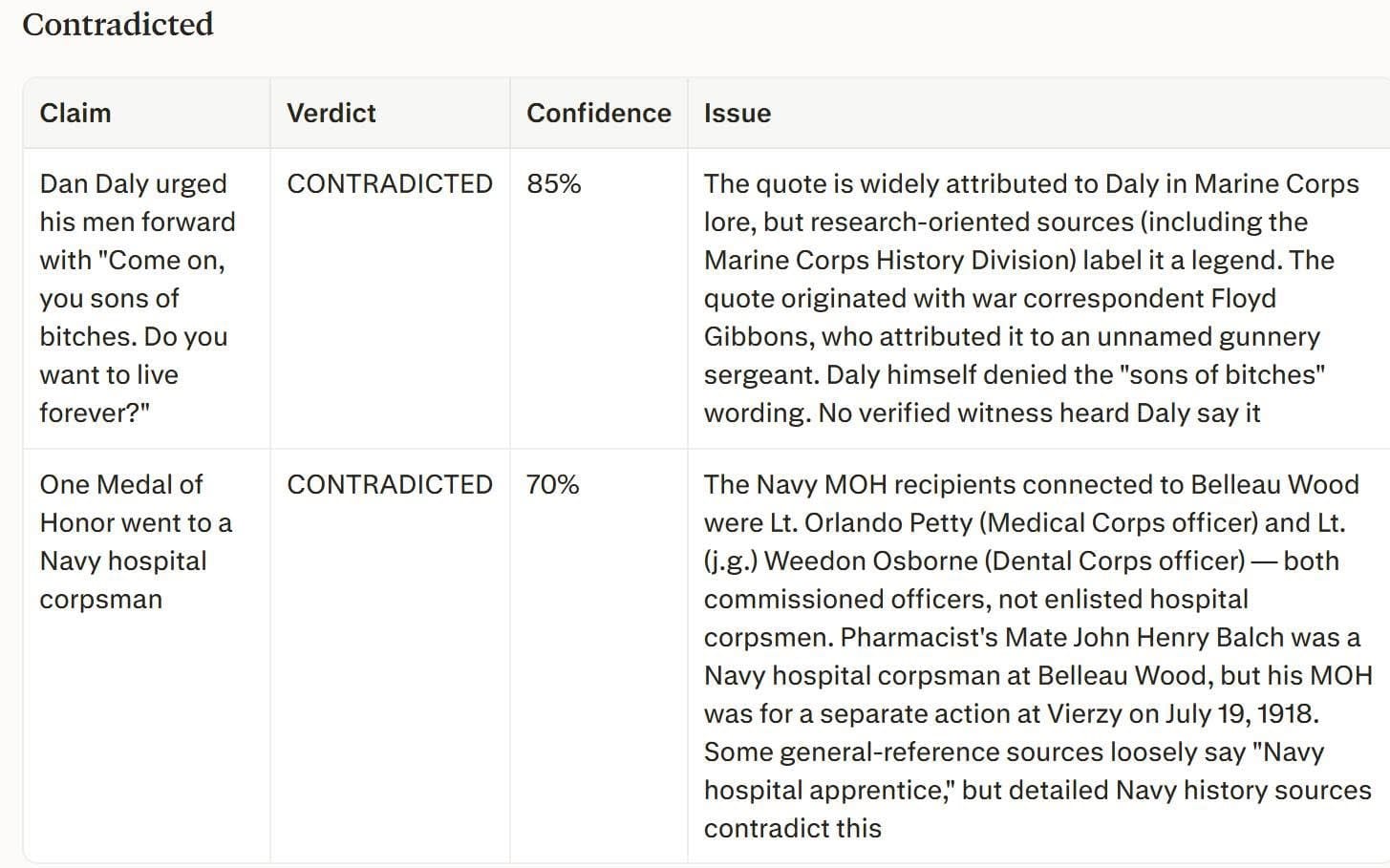
- The famous Dan Daly battle cry — the "do you want to live forever?" line — got flagged as Marine Corps lore, not a verified historical quote. The verifier traced it to war correspondent Floyd Gibbons, who attributed it to an unnamed gunnery sergeant; Daly himself denied the wording. It belongs in the legend column, not the fact column.
- The Medal of Honor detail was just wrong. The original answer described a recipient as a "Navy hospital corpsman." The verifier found the actual recipients in question were commissioned Navy officers — Lt. Orlando Petty of the Medical Corps and Lt. j.g. Weedon Osborne of the Dental Corps — not enlisted corpsmen.
But the part I actually find most valuable isn't the two it killed — it's the five it let through with a warning. These are claims the original answer stated flatly that turn out to be defensible but genuinely contested, and the verifier said so instead of rubber-stamping them:
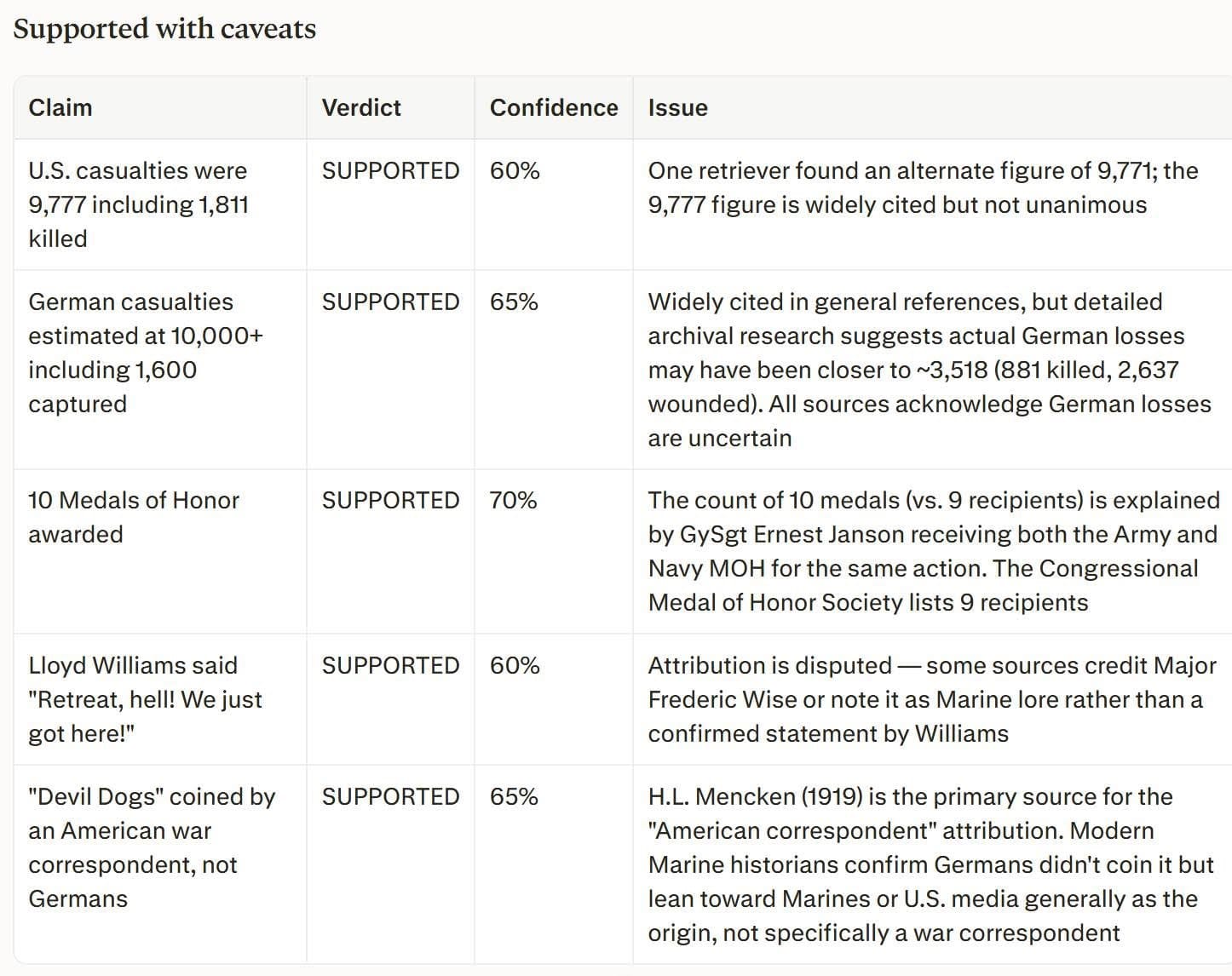
Look at the German casualty line especially: the original answer leaned on "10,000+," which is widely cited — but the verifier flagged that detailed archival work points to a meaningfully lower number (closer to ~3,518) and that all sources admit the figure is uncertain. That's not a model being wrong — that's a model being appropriately unsure on your behalf, which is arguably the most useful thing on this whole list.
And then the app did the thing that started this whole post: handed the corrections back to me and rewrote its own answer. The most advanced model I have, revising itself in real time — not because it suddenly got smarter, but because it was made to answer to something.
Why this actually matters
Here's the takeaway, and it's bigger than one history question.
We've spent a couple of years acting like the path to reliable AI is a leaderboard — next model, bigger model, higher score. But the gains that actually move the needle on trust don't come from the model getting smarter. They come from the architecture you build around it: ensembles of models from different labs, live grounding against real sources, corpora you control, and adversarial verifiers whose only job is to try to prove the answer wrong.
Even the single best model on the market can be improved — measurably — by making it defend its claims to a room full of skeptics that don't share its blind spots. That's not a knock on the model. That's just how you get from "sounds right" to "checked."
The frontier isn't only in the models anymore. It's in the harnesses we wrap around them — and that's the part I keep spending my time on, because that's where reliability actually lives.
If any of this is useful to you, the one-line version is: don't ask a model to grade its own homework. Make a few of them — built by different people, in different ways — check each other, and pay the small tax to ground every claim in something real. It's slower and it isn't free. It's also the difference between an answer you like and an answer you can stand behind.